
Ever-learning in Italy
We’re ever-learners here at Amy Storm & Company. We ask lots of questions, research options, and don’t mind getting our hands dirty. There’s nothing better than learning from experiences and experts–with contractors at a job site, vendors in their show rooms, and other designers at events.
We recently traveled to Italy to learn all that we could about the gorgeous white marble unearthed in Tuscany, and commonly known as Carrara Marble. Turns out, Italy has some incredible shopping and delightful wine, too, so… there was plenty for us to explore. And we learned. A lot.


Our first stop: Florence.
We arrived in Florence a day or two early and wasted no time. After a quick pit stop at Gallery Hotel Art to drop our bags, we ventured out to explore and gather inspiration around the city.
Remember… we’re ever-learners. As such, we caught up on Florence history and all that originated here…
We have Florence to thank for notorious masterpieces such as da Vinci’s Mona Lisa and Michelangelo’s Statue of David. The city is also home to bold fashion designers behind brands like Gucci, Prada, and Fendi. If you need a burst of inspiration... or a new purse... we highly recommend a stroll on Via de’ Tornabuoni.
Even the roots of modern banking are often traced to Italy. During a bike tour of the city, we learned the word salary originated from the Latin word salarium or “salt money.” Back in ancient Rome, salt was so valuable it made up a portion of soldiers’ regular payments. (Next time you hear someone say someone’s “not worth his salt," you’ll know why.)
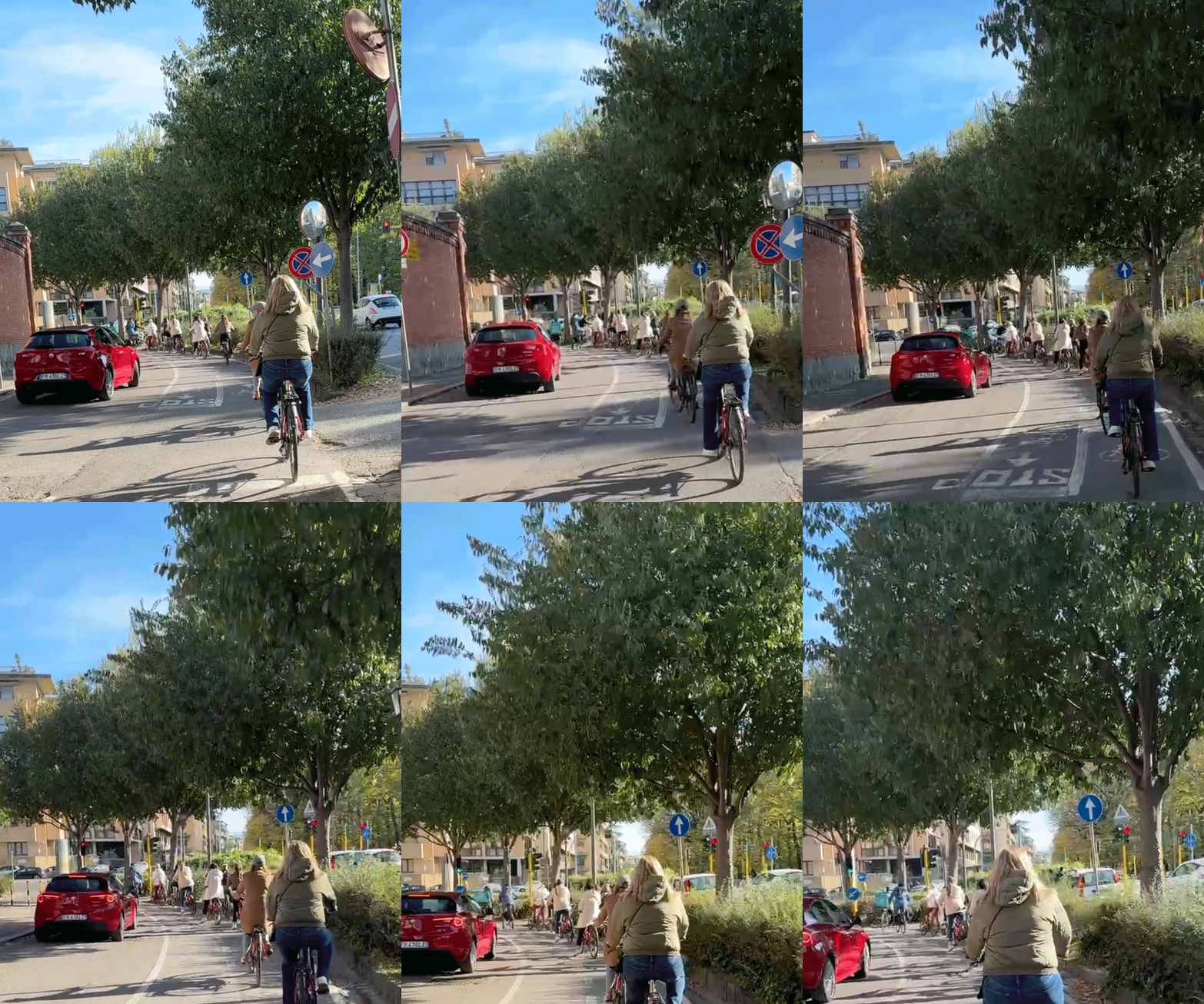
Beyond its rich history, it’s also simply a beautiful city with so much to explore.
Must-Dos?
Walk the Arno River to admire the earthy textures and rich colors around every corner.
Wait in a very long line to order a sandwich on freshly made focaccia bread from All'Antico Vinaio.
Indulge in late-night gelato… or morning gelato, or midday gelato.


Also...
Climb to the top of Piazzale Michelangelo for a spectacular view of the city, particularly at sunrise or sunset. The Duomo is a truly epic sight from here... that scale and those details?! They just don't build like that anymore!
And... perhaps most importantly… order through a wine window! These adorable little portals are a lovely example of how good design evolves with time. Once used to protect public safety, they've been cleverly repurposed just for fun.
Of course, you can't forget to take a stroll down Ponte Vecchio. More than just jewelry, you’ll also find beautiful views of the river, local vendors, and perhaps—if you’re lucky—street performers. You might even find yourself taking a late-night stroll here, and instigating an impromptu dance party, with a group full of strangers. (Guilty!)
There are so many good eats here it's hard to choose. If we had to pick just one... we highly recommend a meal at Osteria del Cinghiale Bianco, which is where we chose to end our trip. Be sure to order family-style so you can try a little of everything.


The backstory on marble.
At this moment, you may be wondering why we took a team vacation... I mean... business trip to Italy. Well… because we’re ever-learners here at Amy Storm & Company, remember?! We have endless curiosity about bettering our understanding of the materials we work with and improving the details we design and doing all the things we do, well… even better!
So, here’s what we know… marble is formed through a process called “metamorphism.” We’re no scientists, but as we understand it, marble starts as sedimentary rock, transformed under intense heat and pressure (like diamonds!) which gives it its density, pattern, and crystal-like finish.
There are countless varieties of marble from all over the world, with all sorts of colors and textures based on the environment and other materials that get caught up in the process. It's mined from regions all over the world—Greece, Turkey, India, and even the United States—but nowhere is more notable or historically significant as Carrara, Italy.
In the Apuan Alps, limestone is what gives Carrara Marble marble its bright white color and mineral impurities create its gray streaks and veining.
So… off to the mountains we went. (Lucky us!)
As you can imagine, marble has been around for a long, long time, but large-scale mining of marble began during the Roman era.
For centuries, marble has been used to build many of the most notable Roman monuments like the Pantheon and Trajan’s Column, as well as to create some of the most notable artwork in history, like the Statue of David by Michelangelo (who, by the way, stands much larger than we ever expected).

Our visit to Carrara.
In Carrara, we met up with the incredible team from Calia Stone Boutique and had an up-close-and-personal visit to the place where it all began, just off the coast of the Liguarian Sea. We paid a visit to the Borghini Quarry, which is where many of Calia Stone’s slabs are sourced—and therefore, where many Amy Storm & Company countertops, marble tiles, etc. come from.
During our visit, they gave us a peek behind the curtain to where the magic happens. We first arrived at the Borghini showroom, at the base of the mountains. Imagine a warehouse full of marble slabs, surrounded by marble mountain views.
Then, we piled into some trucks for a very bumpy ride up the mountains. (Fear of heights? Maybe best to shut your eyes.) At the top, they served us lunch with a view. Italy loves a long lunch and, honestly, so do we! With bellies full of charcuterie and a little bubbly, we got a tour of the mines where stone is cut straight out of the mountain. These stone galleries are so massive it takes your breath away.


One mountain. So many options.
It’s all about the veins and the color. A single mountain might produce a variety of stones—Arabescato, Bianco, Calacatta, Carrara, Statuario. Depending on the area of where they’re mining, the stone will have different characteristics, color and veining. For instance, Calacatta alone has over 15 varieties (Classic, Viola, Michelangelo, Borghini, Monet… we could go on).
In transit.
From a massive stone block in Italy, to the suburbs of Chicago... how is that even possible?! This was the burning question that kind of inspired the whole trip.
There's so much that goes on behind the scenes to make it happen, but we know a little more now that we got a first-hand look. Let us break it down for you.

First things first, they use 3D models to determine the dexterity and safety before making any cuts.
Next, miners strategically and thoughtfully cut a massive block from the mountain.


Once these blocks are cut, they're carefully moved off the mountain.
Remember that bumpy drive up the steep gravel road we talked about? Imagine that but with a block of marble in tow!
From there, the blocks are transferred to a facility where they’re cut into rough slabs, or slices.
We always thought this was done more like cutting bread (a slice at a time) but no... here, all of the slices are sliced all at once.
Then, slabs are moved along the assembly line to be perfected. Here, they use hand saws to remove any irregularities before being finished.
Mesh is applied to the back of the slabs for reinforcement, and to provide stability in case of any cracks or breakage.


Finally, slabs move along a conveyor belt to be finished… you’re probably familiar with honed or polished stone, but it can also be brushed, leathered, or sandblasted. You name it!
Et voila! These finished slabs are transferred to the shipyard, ready to be sent off to showrooms all over the world.
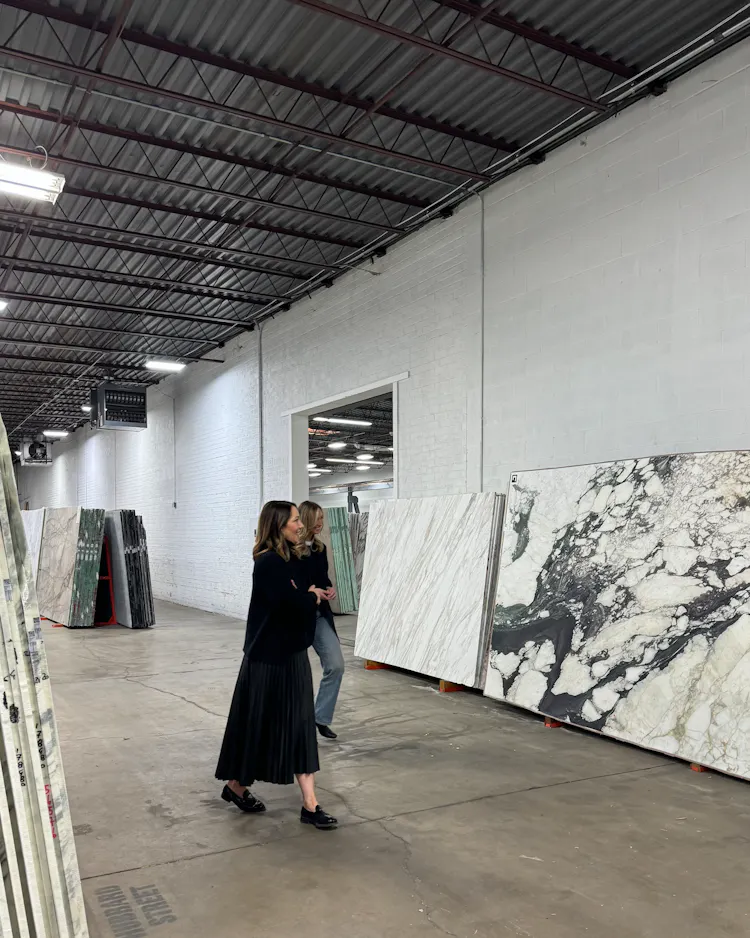
Once the stone arrives to the showrooms, designers like us can oogle at them and take our pick from a wide selection.
Fabricators cut down the slab per the design and details and send us shop drawings for review and approval.
As a last step before reaching its new home, the stone is sealed for protection.*
*If you’re considering natural stone in your project, we suggest you explore different levels of protection from your fabricator, especially if you like marble but can’t handle etching. There are ways to protect it, but they come with a hefty price.
We say… use it, love it, and don’t freak out about it. You may be hesitant about the wear and tear and potential to stain. But if you wander through any city in Europe, you’ll see this stone everywhere, both inside and out. It’s meant to be lived in and gets better with time. Best to embrace it, etches and all!
Finally... a quick Pisa drop-in.
Did you even go to Italy without a pit-stop at the Leaning Tower? We think not. So, we added it to the route, took the necessary pics (some were fairly creative), bought some coffee and some other great stuff, then piled back in the vans… and kept things moving.
We can confirm that it really is a leaning tower!


Phew! There you have it. We went on this Italian expedition so that you don’t have to… but we highly recommend you go see this beautiful place for yourself.
If you do make the trek, be sure to bring:
Comfortable shoes. You’ll want to walk (or bike) everywhere, and you should!
Lots of layers. The weather will vary if you explore the city, mountains, and sea like we did. Give yourself mix-and-matchable options!
An extra bag. Just in case you find… we mean WHEN you find... all kinds of Italian goodies to bring home with you. You'll thank us later.
Until our next adventure, saluti and arrivederci!


